


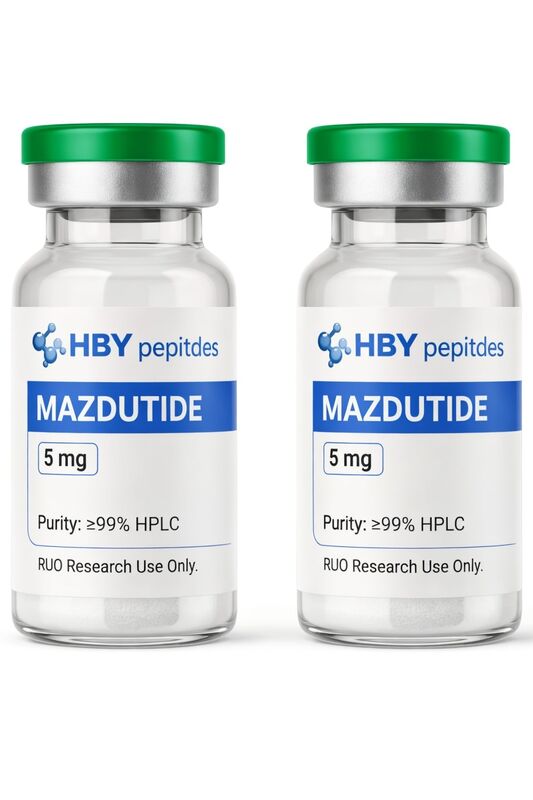

Détails de produit
Lieu d'origine: Chine
Nom de marque: Hongbaiyi
Certification: COA, HPLC MR
Numéro de modèle: HBY-Mazdutide
Documents: Brochure du produit PDF
Conditions de paiement et d'expédition
Quantité de commande min: 5 boîtes
Prix: Négociable
Détails d'emballage: 1 mg ; 5 mg ; 10 mg ; 50 mg ; 100 mg, 1 g ou selon les exigences détaillées du client.
Délai de livraison: 3-5 travail jours après votre paiement
Conditions de paiement: , Western Union, T/T
Capacité d'approvisionnement: 20,000boxes/Month
Nom du produit: |
Mazdutide |
N° CAS.: |
2259884-03-0 |
Résistance à la posologie: |
5 mg par flacon |
Classe / Type: |
Peptide synthétique à action prolongée |
Pureté: |
≥99% (CLHP) |
apparence: |
Poudre lyophilisée |
Nom commun: |
PNB-0408 |
Nom du produit: |
Mazdutide |
N° CAS.: |
2259884-03-0 |
Résistance à la posologie: |
5 mg par flacon |
Classe / Type: |
Peptide synthétique à action prolongée |
Pureté: |
≥99% (CLHP) |
apparence: |
Poudre lyophilisée |
Nom commun: |
PNB-0408 |
Résumé du produit:
Dihexa est un petit composé de recherche synthétique de type peptide avec le numéro CAS 1401708-83-5.Il est principalement étudié dans la recherche en neurosciences pour son rôle potentiel dans la promotion de l'activité neurotrophique et le soutien des voies de croissance synaptiqueEn tant que molécule expérimentale très puissante, Dihexa a été étudiée dans des contextes précliniques pour son interaction avec les voies de signalisation du facteur de croissance des hépatocytes (FGH).qui sont associés aux mécanismes de réparation neuronale et de fonction cognitive.
Ce produit est strictement destiné à la recherche en laboratoire et n' est pas approuvé pour la consommation humaine, l' utilisation médicale ou l' application vétérinaire.adapté à des études expérimentales et analytiques contrôlées dans des environnements de recherche.
1. Substance active
Mazdutide (également connu sous le nom IBI-362 / LY-3305677)
2. Force posologique:
5 mg par flacon
3. classe / type:
Peptide synthétique à action prolongée
Agoniste double de:
4Mécanisme d'action:
Le mazdutide active simultanément le GLP-1R et le GCGR, ce qui peut influencer:
5- La forme physique:
6Caractéristiques moléculaires:
7. Solubilité:
8Conditions de stockage:
9. Statut de l'utilisation de la recherche:

